


Imagine a world where getting a dental crown feels less like a trip to the dentist and more like a visit to a futuristic factory. Welcome to the realm of dental 3D printing, where smiles are crafted with precision and a sprinkle of magic. This innovative technology is revolutionizing the way dental professionals approach everything from crowns to aligners, making the process faster and more efficient than ever.
Overview Of Dental 3D Printing
Dental 3D printing revolutionizes the production of dental devices. This technology streamlines the creation of prosthetics, such as crowns, bridges, and aligners. Dental professionals benefit from rapid prototyping and customization, improving overall workflow efficiency.
Materials used in dental 3D printing include various resins and metals. These materials enhance the longevity and durability of final products. For instance, biocompatible resins support patient safety, while metal printing offers strength for restorations.
Processes involved in dental 3D printing vary based on needs. Stereolithography (SLA) delivers high precision for intricate designs. Digital Light Processing (DLP) provides speed in producing multiple items simultaneously. Selective Laser Sintering (SLS) enables the creation of complex structures with greater material options.
Quality control plays a critical role in the 3D printing process. Regular calibration of printers ensures consistency in production. Additionally, post-processing treatments enhance the finish and functionality of dental items.
Costs associated with dental 3D printing remain competitive. Initial equipment investments are balanced by savings in materials and labor. The reduction of turnaround time directly impacts profitability for dental practices.
Emerging trends in dental 3D printing include integration with artificial intelligence (AI). AI optimizes design processes, reducing errors and improving accuracy. Ongoing research focuses on developing new materials and expanding applications within the dental field.
This innovation not only enhances the efficiency of dental practices but also elevates patient satisfaction. Custom solutions increase comfort and fit for individual patients.
Benefits Of Dental 3D Printing
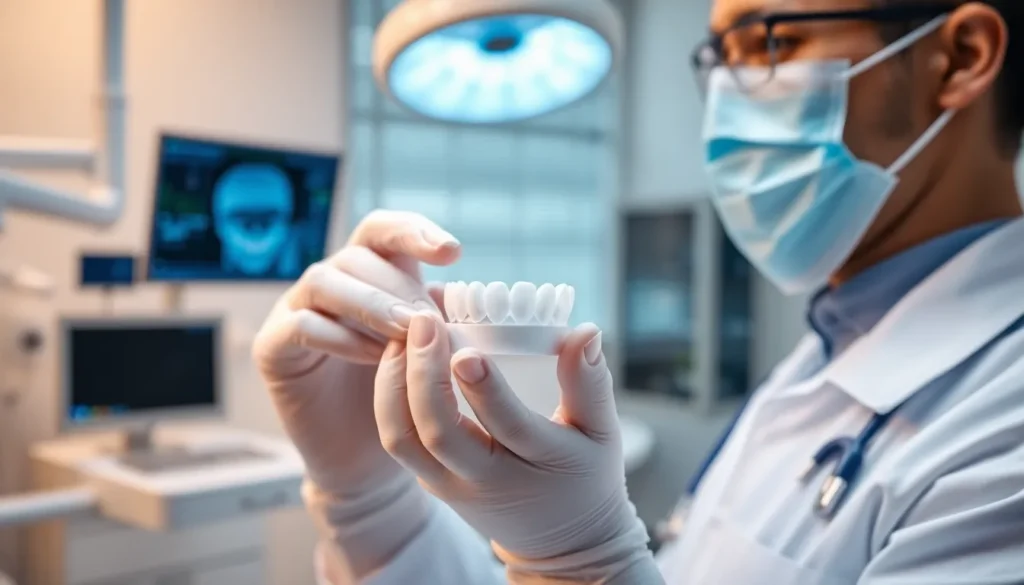
Dental 3D printing offers numerous advantages, significantly enhancing the dental industry landscape. Improved precision and reduced costs stand out as key benefits.
Improved Accuracy
Enhanced accuracy represents one of the major advantages of dental 3D printing. Stereolithography (SLA) and Digital Light Processing (DLP) achieve high levels of detail, ensuring perfect fits for crowns and aligners. Customization allows practitioners to create tailored designs based on individual patient scans, minimizing adjustments and rework. Consistency in output leads to fewer errors, directly impacting patient satisfaction. Comprehensive quality control methods, such as regular calibration, guarantee that every printed device meets the highest standards, reinforcing the importance of this technology in clinical practice.
Reduced Costs
Significant cost reductions accompany the adoption of dental 3D printing. Initial equipment investments, though substantial, yield long-term savings in material and labor expenses. Streamlining the production process lowers turnaround times, enabling practices to manage more patients efficiently. Additionally, the technology’s ability to produce custom pieces on demand eliminates excess inventory costs. Overall, financial benefits arise from increased throughput and decreased operational costs, allowing dental practices to allocate resources effectively while enhancing service delivery.
Applications Of Dental 3D Printing
Dental 3D printing finds diverse applications across several fields, transforming traditional practices into modern, efficient processes.
Prosthodontics
Prosthodontics benefits significantly from dental 3D printing through the creation of precise crowns, bridges, and dentures. Customization allows for better fit, enhancing patient comfort. Moreover, the use of biocompatible materials in producing these devices ensures safety and durability. Speed also plays a pivotal role, as digital impressions allow quicker transitions from design to production. This efficiency supports streamlined workflows, reducing overall treatment times for patients.
Orthodontics
In orthodontics, dental 3D printing delivers innovative solutions such as clear aligners and personalized braces. High-resolution printers create accurate models of patients’ teeth, enabling tailored treatment plans. Design adjustments occur rapidly, accommodating changes in alignment during the treatment process. Additionally, faster fabrication processes contribute to quicker delivery times, which improves patient satisfaction. Overall, this technology increases the effectiveness of orthodontic treatments while minimizing discomfort.
Implantology
Implantology experiences enhanced outcomes through dental 3D printing by allowing for precise surgical guides and customized implants. Custom surgical guides aid in accurate placement, promoting better integration with bone structures. Moreover, the ability to design implants that consider individual anatomical variations results in improved success rates. This technology facilitates detailed imaging, ensuring clinicians have comprehensive data for decision-making. Enhanced precision and customization significantly elevate patient care in implant procedures.
Challenges In Dental 3D Printing
Dental 3D printing faces several challenges that can impact its adoption in practice.
Material Limitations
Material limitations present significant obstacles in dental 3D printing. Few materials currently provide the required strength, durability, and biocompatibility necessary for dental applications. Resins often lack the mechanical properties needed for long-term use, which restricts their effectiveness for certain prosthetics. Metals, while strong, can sometimes be more challenging to print due to their thermal properties. Adaptation to new materials involves rigorous testing, making it a slow process. Additionally, developing resins that match the aesthetic qualities of natural teeth remains an objective for manufacturers.
Regulatory Hurdles
Regulatory hurdles also complicate the integration of dental 3D printing. Various guidelines exist to ensure that dental products meet safety and effectiveness standards. Navigating these regulations can prove time-consuming and costly for dental practices. Each country and region may impose different requirements, creating variability in compliance processes. Manufacturers often face lengthy approval timelines before their products can enter the market. Understanding quality control protocols is essential for practices looking to implement 3D printing technology.
Future Trends In Dental 3D Printing
Continued advancements in dental 3D printing signal exciting possibilities for the industry. Enhanced automation in printing processes leads to greater efficiency and reduced manual labor requirements. Artificial intelligence (AI) integration offers the potential to streamline design workflows, allowing customizations based on patient data with remarkable accuracy.
New materials under research include bioactive resins and advanced polymers, which promise improved strength and biocompatibility. These innovations support better long-term outcomes for patients as devices become more functional and adaptable. Advanced printing techniques, such as multi-material printing, allow for more complex structures and functional devices, pushing the boundaries of what is possible in dental applications.
Increased demand for personalized dental solutions drives the expansion of custom aligners and prosthetics. Customizability enhances patient satisfaction, making treatment more comfortable and effective. Improved scanning technologies also provide more precise digital impressions, further optimizing the design process for 3D printed devices.
Sustainability trends influence material choices and production methods. Eco-friendly materials and processes reduce waste and environmental impact, aligning with global sustainability goals. Greater focus on patient-centered care encourages practices to adopt technologies that enhance the overall dental experience.
Regulatory frameworks will likely evolve to accommodate the rapid growth of dental 3D printing. Streamlined regulations can facilitate faster approval processes, enabling dental practices to adapt quickly. This transition may result in a competitive advantage for early adopters of effective 3D printing strategies.
Overall, the future landscape of dental 3D printing showcases a blend of technological innovation, sustainability, and an emphasis on patient care. As developments unfold, practices embracing these trends stand to reshape the dental experience profoundly.
Dental 3D printing is undeniably reshaping the landscape of dental care. Its ability to deliver customized solutions quickly and efficiently enhances both patient satisfaction and practice profitability. As the technology continues to evolve with advancements in materials and processes, dental professionals are poised to experience even greater benefits.
The integration of AI and improved scanning technologies promises to streamline workflows further while ensuring high-quality outcomes. While challenges like material limitations and regulatory hurdles remain, the ongoing research and innovation in this field are paving the way for a more efficient and sustainable future in dentistry. Embracing these changes will not only improve patient care but also position dental practices at the forefront of modern dental solutions.

