


In a world where waiting for your coffee feels like an eternity, advanced 3D printing is here to save the day—one layer at a time. This technology isn’t just about printing plastic toys or quirky gadgets; it’s revolutionizing industries from healthcare to aerospace. Imagine a future where your next meal could be printed right in your kitchen. Yes, you read that right—dinner could soon be a high-tech affair!
As the capabilities of 3D printing evolve, so does its potential to solve real-world problems. From creating custom prosthetics that fit like a glove to producing intricate parts for rockets, advanced 3D printing is pushing the boundaries of what’s possible. Buckle up, because this isn’t just a trend; it’s the beginning of a manufacturing revolution that’s about to take us into uncharted territory.
Overview of Advanced 3D Printing
Advanced 3D printing represents a significant leap in manufacturing capabilities. This technology encompasses various techniques, including selective laser sintering and fused deposition modeling, allowing for greater precision and efficiency. Industries such as aerospace utilize it to create lightweight components that meet stringent regulatory standards.
Healthcare benefits immensely from advanced 3D printing, as it enables the production of custom prosthetics and implants tailored to individual patients. Surgical planning becomes more effective when surgeons can use anatomically accurate models made through this process.
The automotive sector also embraces advanced 3D printing, streamlining the production of prototypes and parts. It supports rapid iteration, which reduces time and costs associated with traditional manufacturing methods.
Environmental considerations play a crucial role in this technology’s evolution. Advanced 3D printing can minimize waste by using only the necessary materials for production. Additionally, some processes allow for the use of recycled materials, contributing to sustainability efforts.
Educational institutions incorporate advanced 3D printing into their curricula, teaching students vital skills for future careers. This technology fosters innovation and encourages experimentation, shaping the next generation of engineers and designers.
Customization represents a key advantage of advanced 3D printing. Consumers now expect personalized products, and this technology meets those expectations efficiently. Whether it is personalized eyewear or custom-fit athletic gear, the possibilities are virtually limitless.
Overall, advanced 3D printing stands at the forefront of modern manufacturing, promising innovative solutions to various challenges across multiple sectors. As the industry evolves, it continues to push the boundaries of what is possible, introducing new materials and processes that enhance its applications.
Key Technologies in Advanced 3D Printing
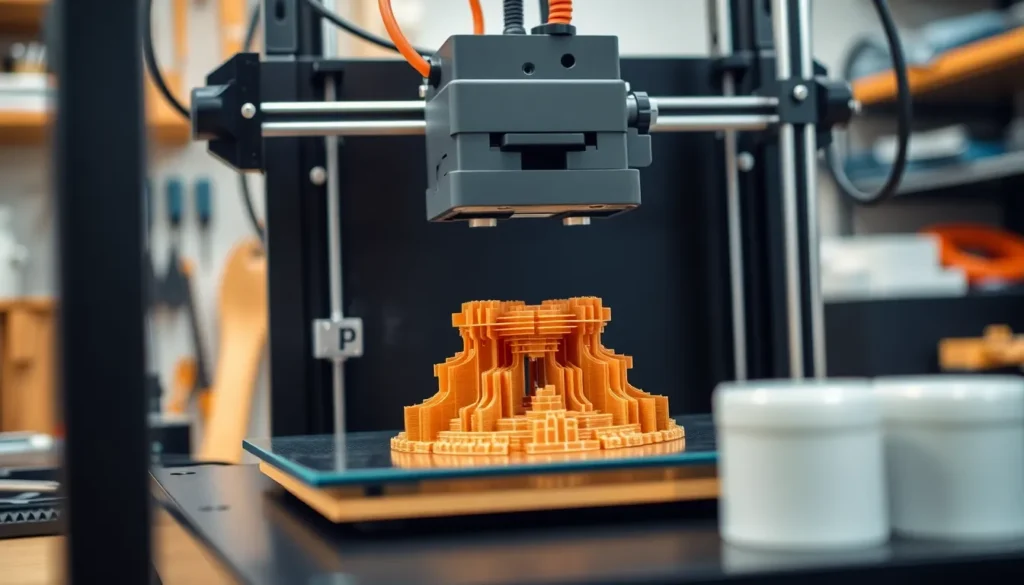
Advanced 3D printing employs various key technologies, each contributing uniquely to its capabilities and applications.
Material Extrusion
Material extrusion primarily refers to the method where thermoplastic filaments are heated and extruded through a nozzle. This process allows for significant customization in designs, making it popular in the production of prototypes and finished products. Filaments, such as PLA and ABS, provide different mechanical properties, enabling a range of uses from toys to functional parts. Layer-by-layer construction enhances design complexity without increasing costs. This technique effectively reduces material waste, promoting sustainability in manufacturing.
Powder Bed Fusion
Powder bed fusion encompasses several methods, including selective laser sintering and electron beam melting. In this process, a laser or electron beam selectively fuses powdered materials, typically metals or polymers, to create strong, durable components. Precision in this technique allows for intricate geometries that traditional methods struggle to achieve. Parts produced are often lighter than those created through subtractive manufacturing. Industries like aerospace and medical benefit from its ability to produce complex structures with high reliability, enhancing product performance and reliability.
Applications of Advanced 3D Printing
Advanced 3D printing finds numerous applications across various industries, drastically altering manufacturing processes and product development.
Aerospace Industry
The aerospace industry leverages advanced 3D printing to create lightweight components that enhance fuel efficiency. Manufacturers utilize techniques such as selective laser sintering to produce intricate designs, which meet rigorous safety standards. Parts like brackets and housings benefit from this technology, reducing overall production costs while maintaining structural integrity. Several companies report that using 3D printed components enables faster assembly and integration. Additionally, the ability to quickly prototype parts accelerates innovation, allowing engineers to iterate designs rapidly and optimize performance efficiently.
Medical Field
Advanced 3D printing revolutionizes the medical field by enabling the creation of custom prosthetics and personalized surgical models. Surgeons rely on anatomically accurate replicas for planning complex procedures, improving patient outcomes. Custom implants tailored to individual needs exhibit enhanced compatibility and comfort. Several healthcare providers use this technology to fabricate dental devices and orthopedic braces, streamlining production timelines. Furthermore, bioprinting is emerging as a promising technique, potentially enabling the creation of tissue for regenerative medicine. This innovation signals significant advancements in personalized healthcare solutions.
Benefits of Advanced 3D Printing
Advanced 3D printing offers numerous advantages across various sectors. Cost savings result from reduced material waste and decreased production timelines. Manufacturers often see lower expenses associated with traditional production processes. Customization allows companies to tailor products to individual needs, enhancing customer satisfaction.
The ability to create complex designs significantly impacts various industries. Aerospace engineers can produce lightweight components that improve fuel efficiency and meet regulatory demands. Medical professionals benefit from developing intricate prosthetics and surgical models, leading to better patient outcomes.
Sustainability plays a vital role in this technology’s benefits. Advanced 3D printing minimizes waste by using only the necessary materials and often incorporates recycled substances. Educational institutions engage students with this technology, encouraging innovation and preparing them for future challenges.
Emerging techniques such as bioprinting promise exciting possibilities for regenerative medicine. These advances could eventually lead to the creation of replacement organs, addressing critical shortages in healthcare. Enhanced performance and reliability, particularly in high-stakes industries, result from stronger and lighter components created through techniques like powder bed fusion.
Personalization trends see increased demand for customized products like eyewear and fitness equipment. Shifting consumer preferences push companies to adopt advanced 3D printing methods to stay competitive. Overall, the benefits of this technology significantly propel advancements across multiple fields, fostering a more efficient and innovative manufacturing landscape.
Challenges and Limitations
Advanced 3D printing faces multiple challenges that hinder its widespread application. High production costs remain a significant barrier, as the price of advanced materials and equipment can deter smaller manufacturers. Variability in print quality presents another constraint; inconsistent results can arise from differences in environmental conditions or equipment calibration.
Material limitations contribute to these challenges. Not all materials are suitable for advanced printing, restricting design options. Compounding this issue, limited understanding of new materials among some manufacturers can lead to ineffective use, resulting in failures in final products.
Regulatory hurdles add complexity, particularly in industries like healthcare and aerospace. Compliance with medical device regulations can delay the introduction of innovative prints. Moreover, quality assurance processes often lack standardization across sectors, creating additional obstacles for manufacturers aiming to meet industry standards.
Intellectual property concerns create further limitations. As 3D printing facilitates easy replication of designs, protecting original concepts becomes challenging. This situation leads to potential legal disputes, discouraging innovation among creators.
Scalability issues also emerge. While 3D printing excels in rapid prototyping, mass production capabilities remain underdeveloped for some processes. As demand for high-volume production increases, manufacturers encounter difficulties in meeting output expectations without sacrificing quality.
Lastly, the technology’s impact on labor markets raises concerns. Automation may lead to job displacement in traditional manufacturing roles. As advanced 3D printing continues to evolve, addressing these challenges will be vital for unlocking its full potential across various industries.
Future Trends in Advanced 3D Printing
Advanced 3D printing technology is set to evolve rapidly, influencing various sectors with cutting-edge applications. Medical advancements, including bioprinting, may lead to lab-grown tissues and even organs, addressing significant healthcare shortages. Custom prosthetics will become more sophisticated, tailored precisely to individual patient needs.
Sustainability efforts will gain momentum as companies adopt eco-friendly materials. Innovations in biodegradable filaments may significantly reduce environmental impact. Industries will likely embrace circular economy practices, reusing materials to limit waste while promoting efficiency.
The integration of artificial intelligence in 3D printing will optimize design processes and streamline production workflows. Companies could leverage AI algorithms to enhance quality control, predicting potential failures before they occur. Such advancements will improve print accuracy and consistency across various applications.
Education will continue evolving as institutions adopt advanced 3D printing technologies in curricula. Students will gain hands-on experience, preparing for careers in diverse fields such as engineering, healthcare, and design. This educational focus may lead to a new wave of innovators driving future developments in the industry.
Collaboration between technology firms and traditional manufacturing companies will foster innovation. By combining expertise, these partnerships can overcome current challenges and enhance the scalability of 3D printing solutions. Such cooperation aims to address regulatory hurdles and improve material options, making advanced 3D printing more accessible.
Consumer demand for personalization will also shape product offerings, with options ranging from customized athletic gear to home decor items. People will increasingly seek unique, tailor-made solutions that meet their specific preferences.
These trends indicate a vibrant future for advanced 3D printing, with continued advancements paving the way for breakthroughs across multiple industries. Production processes will become faster, more efficient, and more responsive to consumer needs.
Advanced 3D printing is reshaping industries by offering innovative solutions to complex challenges. Its ability to create customized products efficiently and sustainably positions it as a cornerstone of future manufacturing. As technology continues to evolve, the integration of AI and collaboration with traditional sectors is likely to enhance its capabilities further.
The potential for advanced 3D printing to revolutionize healthcare and aerospace is just the beginning. With ongoing advancements and a focus on sustainability, this technology is set to redefine how products are designed and produced. Embracing these changes will be essential for industries aiming to remain competitive in a rapidly changing landscape.

