


In a world where everything seems to be getting flatter, 3D printing is here to add some much-needed dimension. Imagine transforming your wildest ideas into tangible products faster than you can say “layer by layer.” Whether it’s a quirky coffee mug that screams personality or a prototype that could revolutionize an industry, 3D printing has turned the impossible into the possible.
Gone are the days of boring, cookie-cutter products. With 3D printing, creativity knows no bounds. It’s like having a magic wand that turns digital designs into real-world objects. From custom jewelry to intricate home decor, the possibilities are endless. So grab your imagination and let’s dive into the fascinating world of 3D printed products—where innovation meets fun and every layer tells a story.
Overview of 3D Printed Products
3D printed products represent a revolution in manufacturing, enabling creativity and precision like never before. This technology transforms digital designs into physical objects, offering unprecedented customization options.
Definition and Technology
3D printing is an additive manufacturing process that creates objects layer by layer from a digital file. Numerous materials, such as plastics, metals, and ceramics, serve as the foundation for these creations. Technologies like Fused Deposition Modeling (FDM) and Stereolithography (SLA) play pivotal roles in achieving high accuracy. FDM employs melted filament layers to construct items, whereas SLA utilizes ultraviolet light to harden resin layers continuously. Notably, applications span various sectors, including healthcare, automotive, and aerospace, showcasing its versatility.
Historical Development
3D printing’s origins date back to the 1980s when Charles W. Hull invented Stereolithography. This innovative method allowed the first rapid prototyping. By the 1990s, companies such as 3D Systems and Stratasys popularized the technology further, developing various printing techniques. In the 2000s, advancements in material science opened new horizons, expanding the range of printable materials. The rise of open-source hardware in the early 2010s contributed to the democratization of 3D printing. As a result, hobbyists and small businesses gained access to affordable 3D printers, enhancing creativity and innovation globally.
Types of 3D Printed Products
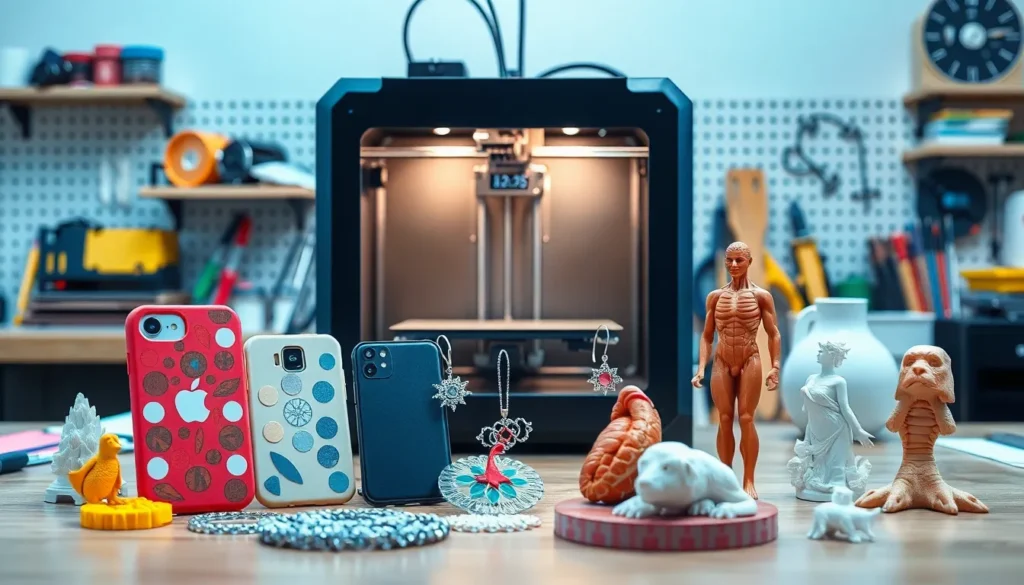
A variety of 3D printed products exist across multiple sectors, reflecting the versatility of this technology. Below are key categories of 3D printed products.
Consumer Goods
3D printing plays a significant role in consumer goods, allowing for personalized products like phone cases, jewelry, and home decor. Such items often feature unique designs suited to individual preferences. Faster production times lead to quicker market entry for these goods. Brands utilize 3D printing for limited edition releases, enhancing their appeal with exclusivity. Manufacturers frequently employ materials such as PLA or nylon to create durable and visually striking consumer products.
Medical Applications
In the medical field, 3D printing offers groundbreaking advancements. Customized prosthetics and dental implants highlight this innovation, crafted to fit individual patient needs precisely. Surgical models enhance pre-operative planning by providing realistic anatomical representations. Bioprinting technologies continue to evolve, facilitating tissue engineering and organ printing. According to recent studies, these applications have the potential to reduce surgical times and improve patient outcomes dramatically.
Industrial Uses
Industrial sectors leverage 3D printing for prototyping and production of complex parts. Such technology streamlines the design process, allowing for rapid iterations of product designs. Aerospace and automotive industries benefit significantly from lightweight components that optimize performance. Tools and fixtures produced via 3D printing often enhance manufacturing efficiency. Moreover, additive manufacturing permits reduced material waste, contributing to more sustainable practices in production.
Advantages of 3D Printed Products
3D printed products offer significant benefits, revolutionizing how items are designed and manufactured. These advantages include customization and cost efficiency, essential in today’s market.
Customization and Personalization
Customization emerges as a primary benefit of 3D printing. It allows individuals to create products tailored to their specific preferences, whether in aesthetics or functionality. Unique designs, from custom phone cases to personalized jewelry, cater to individual tastes and requirements. In medical applications, customization leads to bespoke prosthetics and implants, enhancing the fit and comfort for users. Each product can reflect personal identity or specific needs, meeting demands that traditional manufacturing struggles to fulfill.
Cost Efficiency
Cost efficiency plays a crucial role in the appeal of 3D printed products. Traditional manufacturing often involves significant upfront expenses for molds or tooling, whereas 3D printing eliminates these costs. Producing items on demand reduces waste and lowers inventory costs. This approach allows businesses to invest in shorter production runs without sacrificing quality. Additionally, the speed of production minimizes labor costs and streamlines supply chains, making it an attractive option for startups and small businesses.
Challenges and Limitations
3D printing faces several challenges and limitations that can affect its widespread adoption. These issues encompass material constraints and regulatory hurdles.
Material Constraints
Materials for 3D printing vary significantly, influencing the types of products that can be created. While plastics, metals, and ceramics are popular, not all materials exhibit the same properties. Some materials may not have the strength or durability needed for specific applications, limiting their use. Additionally, the variety of filaments available can lead to compatibility issues, restricting design possibilities. Innovations are underway to develop more advanced materials, yet achieving common standards remains a challenge.
Regulatory Issues
Regulatory issues pose a significant barrier to the growth of 3D printed products. Current regulations often lag behind technological advancements, leading to uncertainty in compliance requirements. Safety standards for medical devices, for instance, might not adequately address 3D printed items, creating potential risks. Intellectual property concerns also arise, with the ability to reproduce designs easily leading to disputes. As the industry evolves, regulatory frameworks must catch up to ensure safe and responsible use of 3D printing technologies.
The world of 3D printed products stands at the forefront of innovation and creativity. As technology continues to evolve it unlocks new possibilities for personalized and efficient manufacturing. The ability to create unique items tailored to individual needs is revolutionizing industries from consumer goods to healthcare.
While challenges remain such as material limitations and regulatory hurdles the potential for growth is immense. Embracing 3D printing not only enhances creativity but also drives sustainability by minimizing waste and optimizing production processes. As more people explore this technology the future of 3D printing promises to be bright and full of opportunities.

