


Imagine a world where your wildest ideas leap off the page and into reality, all thanks to a magical box that transforms digital dreams into tangible objects. Welcome to the realm of 3D printing technology, where creativity meets innovation in the most mind-blowing ways. From quirky toys to life-saving medical devices, this technology’s not just for tech geeks anymore; it’s for anyone with a sprinkle of imagination and a dash of ambition.
Overview of 3D Printing Technology
3D printing technology creates objects layer by layer from digital models. This process, known as additive manufacturing, uses materials like plastics, metals, and ceramics. A variety of techniques exist, such as Fused Deposition Modeling (FDM) and Selective Laser Sintering (SLS), each with unique applications and benefits.
Many industries benefit from 3D printing. In healthcare, it produces custom prosthetics and organs for research. In aerospace, lightweight components improve fuel efficiency. Manufacturing sectors utilize this technology to develop prototypes rapidly, reducing time to market.
Customization stands out as a significant advantage. Traditional manufacturing often limits personalization due to high costs. 3D printing allows tailored solutions without extensive retooling. Designers can adjust sizes and features easily, meeting specific customer needs.
Environmental benefits contribute to growing interest. This technology reduces material waste compared to subtractive methods, where excess material gets cut away. Local production minimizes transportation emissions, supporting sustainability initiatives.
Education and hobbyist communities also embrace 3D printing. Schools incorporate it into curricula, enhancing student engagement in STEM subjects. Hobbyists create everything from art pieces to functional tools, fostering creativity and innovation.
Cost-effective options exist, making 3D printing more accessible. Many desktop printers target consumers and small businesses, encouraging experimentation. Online resources and communities support users with tutorials and design files, fostering a collaborative learning environment.
Overall, 3D printing technology continues to transform industries and everyday life, contributing to advancements in design, production, and sustainability.
Applications of 3D Printing Technology
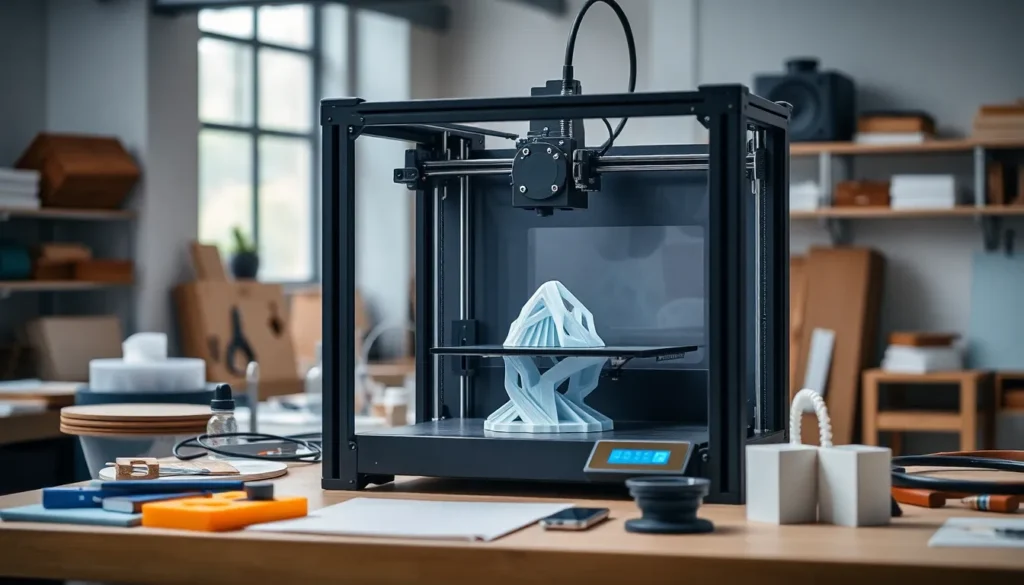
3D printing technology finds diverse applications across various sectors. It enhances efficiency and innovation in each field.
Manufacturing and Prototyping
Manufacturers utilize 3D printing for rapid prototyping, reducing the time needed to develop new products. Production teams create complex designs that traditional methods cannot easily produce. Fused Deposition Modeling (FDM) allows users to test materials and forms quickly. Shortened production cycles lead to faster market launches. Localized printing further minimizes costs associated with shipping and inventory.
Healthcare Innovations
Healthcare benefits significantly from 3D printing technology. Customized prosthetics and implants cater to individual patient needs, improving outcomes. Surgeons create anatomical models from scans, allowing for better pre-surgical planning. Bioprinting advances tissue engineering, enabling the development of organs for research and transplant purposes. Overall, these innovations enhance patient care and streamline surgical procedures.
Architectural and Construction Uses
In architecture and construction, 3D printing transforms design and building processes. Architects produce detailed models for client presentations, allowing for better visualization of projects. Construction companies leverage large-scale printers to create building components, increasing efficiency. These techniques reduce material waste and construction time. Enhancing design flexibility permits architects to experiment with shapes and structures previously deemed impractical.
Advantages of 3D Printing Technology
3D printing technology provides several notable advantages across various sectors. Its capabilities enable significant innovation and enhanced efficiency.
Customization and Personalization
Customization stands as a hallmark of 3D printing technology. Individuals can design products tailored to specific needs, whether in healthcare or consumer products. Medical professionals often create prosthetics designed to fit the exact contours of a patient’s body. Furthermore, consumers enjoy personalized items, such as custom jewelry or bespoke home décor. The immediacy of 3D printing allows for rapid modifications to designs, facilitating unique solutions that traditional manufacturing struggles to match.
Cost-Effectiveness
Cost-effectiveness drives the adoption of 3D printing in numerous industries. Manufacturers benefit from reduced prototyping costs, as the technology enables quick iterations without expensive molds or tooling. Companies often produce small batches of items without incurring high overhead costs, promoting flexibility in production. Additionally, businesses minimize waste by using only necessary materials, leading to significant cost savings. This affordability opens doors for startups to compete with established businesses and encourages innovation across the board.
Sustainability
Sustainability emerges as a crucial advantage of 3D printing technology. Reducing material waste forms a core benefit since the additive process builds objects layer by layer, unlike traditional subtractive methods. This efficiency limits excess material and energy consumption. Furthermore, localized production minimizes transportation emissions, as goods can be printed on-site. Many businesses pursue eco-friendly materials, contributing to broader environmental benefits. Overall, 3D printing technology stands as a vital tool for advancing sustainability while meeting increasing consumer demands.
Challenges and Limitations
3D printing technology faces several challenges and limitations that can impact its widespread adoption and effectiveness.
Material Constraints
Materials used in 3D printing influence printed object’s durability and applications. Various printers often accommodate specific materials, including plastics, metals, and ceramics. Depending on the material, the final strength can vary, limiting potential uses. Not all materials are compatible with every printing method, restricting creativity and flexibility. High-performance materials, essential for critical applications, may incur elevated costs and require specialized equipment. Users seeking advanced properties like heat resistance or conductivity find limited availability in accessible materials.
Regulatory and Safety Issues
Regulatory frameworks regarding 3D printing remain underdeveloped, leading to uncertainty in compliance. Ensuring product safety becomes challenging due to the lack of established standards across industries. 3D printed items may not undergo the same rigorous testing as traditional manufactured goods, posing potential risks. Specific sectors, like healthcare, face additional scrutiny because any defects can directly affect health outcomes. Intellectual property concerns also arise, complicating the landscape where designs can easily be replicated. As technology evolves, clear guidelines must emerge to navigate these issues effectively.
Future Trends in 3D Printing Technology
Innovation in 3D printing continues to evolve, shaping future applications and materials. Metal 3D printing techniques are gaining ground, particularly in industries requiring strong and lightweight components, like aerospace and automotive. Demand for bioprinting is rising; this technique creates living tissues, which significantly impacts healthcare by enabling advancements in organ transplants and regenerative medicine.
Sustainability initiatives are becoming a priority among manufacturers. Using recyclable materials and reducing waste through efficient production processes are major trends within the industry. Companies are increasingly adopting closed-loop systems to minimize their environmental footprint, aligning with global sustainability goals.
Automation in 3D printing technology is also making strides. Integration with artificial intelligence streamlines design and production processes, allowing for rapid iterations and enhanced accuracy. Efforts to improve user experience through simplified software interfaces make this technology even more accessible for non-technical users.
Healthcare is a primary focus for future developments. Customized medical solutions, such as tailored prosthetics and implants, improve patient outcomes significantly. Moreover, advancements in regulatory frameworks seek to ensure the safety and compliance of 3D printed medical devices.
Education and workforce development represent another emerging trend. Institutions are incorporating 3D printing in curricula to prepare students for future careers. Hands-on experience with this technology fosters creativity and problem-solving skills vital for innovation in various fields.
Overall, future trends in 3D printing technology promise to revolutionize industries, improve product quality, and promote sustainability while enhancing educational opportunities for the next generation.
3D printing technology is reshaping the way industries approach design and production. Its ability to create customized solutions while minimizing waste makes it a game-changer in various sectors. As advancements continue in materials and techniques, the potential applications seem limitless.
With growing interest in educational settings and among hobbyists, more people are discovering the benefits of this innovative technology. The future looks bright as 3D printing evolves, promising to enhance not only manufacturing and healthcare but also sustainability efforts. Embracing these innovations can lead to transformative changes that benefit society as a whole.

